Hello,
Sorry it has been a while since posting, it has been so good to be back busy and doing what we love. Whilst the pandemic is very much still ongoing, it has been so refreshing to be able to remain open and see our lovely customers every day. We hope there will be no more lockdowns!
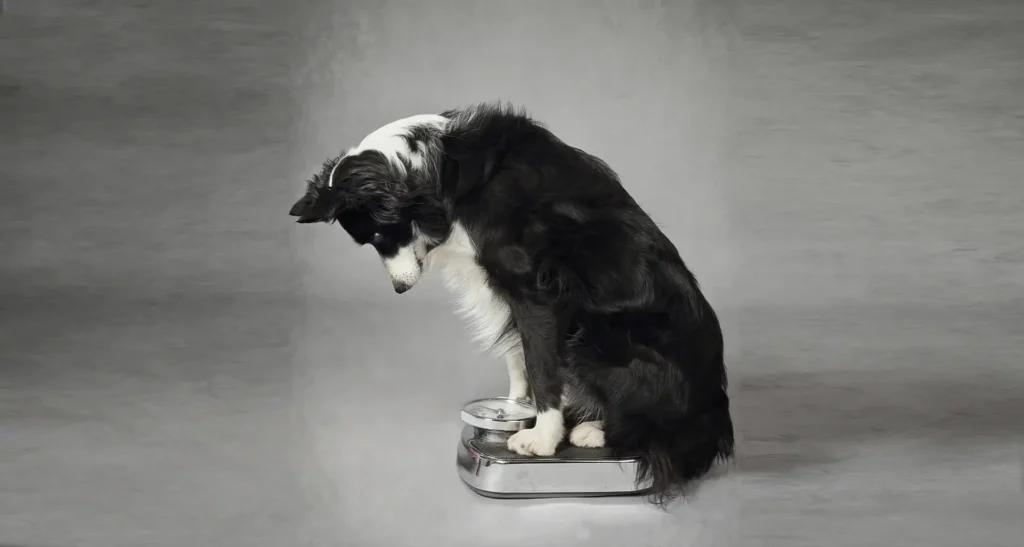
One thing that was common for a lot of people during the last year and a half was gaining a few extra pounds, this has been the same for our dogs. We have noticed more dogs that are overweight have been struggling to remain standing when being groomed. Whilst dogs and humans come in all beautiful shapes and sizes – it is important to remember how carrying too much weight can dramatically shorten a dog’s lifespan. It can also impact their quality of life, damaging their joints and making the long adventurous walks they so love, into something they cannot enjoy.
There are a few clues to tell if your dog is overweight…firstly you can always check with your vet the ideal weight range for your dog, you can keep an eye on this when they go for a check-up, or if you can get them on the scales yourself. As a general rule if your dog is between 15%-20% over its ideal weight they are classed as obese. The simplest way you can gauge whether your dog is overweight or obese is to see if you can feel their ribs but they aren’t too prominent through their fur and body tissue, then your dog is most likely at a healthy weight. If you cannot feel their ribs then it is likely they are overweight or obese. Other ways to tell would be their behaviour, you may notice your dog is becoming lethargic or out of breath more easily, this could also indicate that they are carrying around more weight than is ideal.
Some of you might be thinking – well what more can I do, I always ensure my dog has the right amount of food and the right amount of exercise…but I want to bring your attention to what your dog’s food is made of. I have always researched what goes into my dog’s food and wanted to share some of my findings and some useful resources which can help you to do the same. After all, all dogs are different, but all deserve to be happy and healthy.
Before purchasing any dog food, I always read up on the below website:
https://www.allaboutdogfood.co.uk/
Now, most of you will have probably heard me speak about this before as it is something I am so passionate about, and of course please make your own decision. But I must warn you about Bakers Dog Food and urge you to consider alternatives for your dogs. Whilst it is still a widely popular brand, I think people just don’t realise what it contains. Below is some information that is widely available on the internet, so please read and decide for yourself.
The law has recently changed around what information foodstuff manufacturers have to print on their packaging and they are no longer able to state ‘permitted colours/additives’ on products sold in quantities greater than 10kg. This means you can read what ingredients are going into your dog’s food. Additives in food can cause a number of physical and behavioural concerns seen in dogs – imagine feeding your child nothing but fast food, you can imagine how quickly this would impact their health. Well dogs are the same, they need healthy balanced diets, not E numbers. Below is a list of E numbers that have been found in dog foods.
E320 – has been found to be tumour-producing when fed to rats. In human studies it has been linked with urticaria, angioedema and asthma
E321 – banned for use in food in Japan, Romania, Sweden, and Australia. The US has barred it from being …used in infant foods. So bad McDonalds have voluntarily eliminated it from their products.
E310 – Banned from children’s foods in the US because it is thought to cause the blood disorder methemoglobinemia
E172 – Banned in Germany
E132 – Can cause skin sensitivity, a rash similar to nettle rash, itching, nausea, high blood pressure and breathing problems. One of the colours that the Hyperactive Children’s Support Group recommends be eliminated from the diet of children. Banned in Norway.
E102 – TARTRAZINE – A trial on 76 children diagnosed as hyperactive, showed that tartrazine provoked abnormal behaviour patterns in 79% of them
E110 – Sunset Yellow has been found to damage kidneys and adrenals when fed to laboratory rats. It has also been found to be carcinogenic when fed to animals
E104 – One of the colours that the Hyperactive Children’s Support Group recommends be eliminated from the diet of children. Banned in Australia, Japan, Norway and the United States.
E171 – Banned in Germany
E153 – Banned as a food additive in the United States of America. Suspected as a carcinogenic agent.
Of course, it is up to you to decide what you feed your dog, but please make an informed decision. Do your research and don’t be fooled by marketing ploys like coloured or shaped dog food!